Green House Homes: Nursing Care Without the Institution
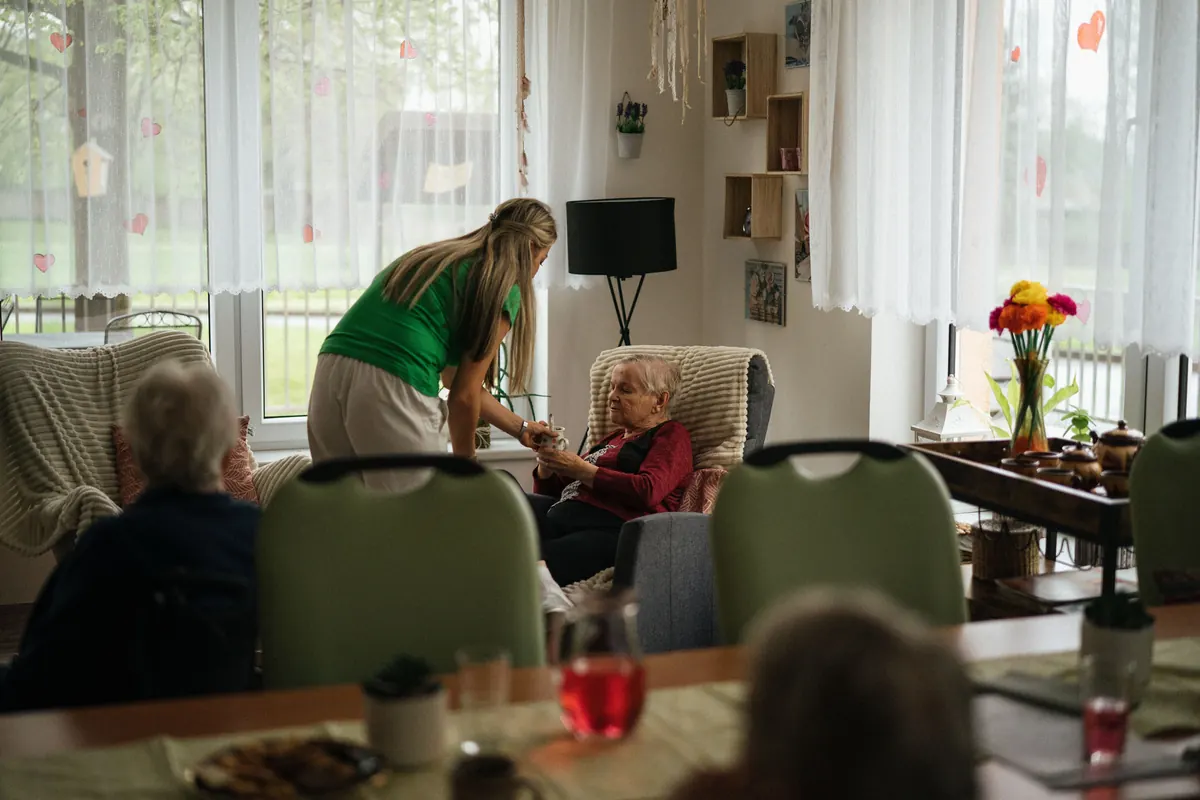
If your parent needs nursing home care but dreads a long corridor of shared rooms, green house nursing homes offer a different shape for the same level of care. You may be searching after a hospital discharge gave you a short list of facilities and little time to compare them.
Sources: Rabig and colleagues, The Gerontologist 2006; Centers for Medicare and Medicaid Services, Health Care Financing Review, Winter 2008-2009; Commonwealth Fund summary of Kane and colleagues 2007; AARP Long-Term Services and Supports Choices, Small-House Nursing Homes; accessed October 2026.
What a Green House home looks like
A Green House home is a single-story house built for 10 to 12 residents, each with a private bedroom and a full bathroom. Bedrooms open onto a shared living area with a hearth, dining table, and full kitchen. Residents choose when to rise, eat, and join activities where their care allows.
Several Green House homes usually sit together on one campus and together hold a nursing home license. That grouping matters for cost and regulation, because the homes operate within the state's usual nursing home rules and reimbursement levels, per the Centers for Medicare and Medicaid Services review of the model.
The Shahbazim: one team for the whole house
Care in a Green House home comes from Shahbazim, universal caregivers who handle personal care, cooking, housekeeping, laundry, and activities for the same small group of residents. A Guide supervises each team, and a visiting clinical support team of nurses, therapists, and other professionals handles medical care, so the Shahbazim are not a substitute for nursing staff.
The steady team is the model's main bet: the same caregivers learn how your parent likes meals, sleeps, and spends the day, and they notice small changes sooner than a rotating roster might.
Where the model started
Dr. William Thomas, a geriatrician, designed the Green House model . The first four Green House homes opened in Tupelo, Mississippi, in June 2003, on the campus of a retirement community. Forty residents moved from a 140-bed nursing home into those houses, including 20 residents from the locked dementia unit, per the 2006 Gerontologist account.
The Robert Wood Johnson Foundation pledged $10 million in 2005 to spread the model across the United States, and NCB Capital Impact administered the program. Growth since then has been steady but small next to the whole nursing home sector, so a Green House home may not exist near your parent.
What research says, without overstating it
A longitudinal study of the first Green House program, summarized by the Commonwealth Fund, found that Green House residents reported higher emotional well-being scores and greater satisfaction with the home as a place to live and a place to get care than residents in the comparison nursing homes. On minimum data set quality measures, Green House residents showed lower rates of depression, bed rest, reduced activity, and decline in function than both comparison groups.
Later work kept the picture mixed. A later study of 242 residents found that Green House residents had a lower rate of increase in the chance of not being socially engaged over time, but a higher rate of increase in depressive symptoms than traditional home residents. AARP's summary reports a 2015 study finding that Green House residents were 16 percent less likely to be bedridden, 38 percent less likely to have pressure ulcers, and 45 percent less likely to have catheters than traditional nursing home residents, and it also states that existing studies are limited in scope and further research is needed.
Green House home against a traditional nursing home
| Feature | Green House home | Traditional nursing home |
|---|---|---|
| Size | 10 to 12 residents per house | Often 100 or more residents per building |
| Room | Private bedroom and full bathroom each | Private or shared rooms, by facility |
| Meals | Cooked in the house kitchen, shared table | Central kitchen, dining room service |
| Daily schedule | Resident chooses times where care allows | Set by facility routine and shifts |
| Caregivers | Steady Shahbazim team plus clinical team | Rotating nursing and aide shifts |
| License | Nursing home license, usually as a campus group | Nursing home license for the building |
| Availability | Few homes in most states; waitlists common | Widely available in most areas |
Judge a specific house on its inspection record and staff tenure, not on the model name alone.
What a Green House home costs
There is no single Green House price, because each home sets its own private-pay rate for its local market. In green house nursing homes licensed as traditional nursing homes, Medicaid and Medicare reimbursement follows the same lines as a traditional nursing home, and for Medicaid the costs are equivalent to the traditional Medicaid costs for nursing homes. If a home is licensed as assisted living instead, Medicaid reimbursement depends on that state's assisted living provisions, so the license type changes the payment answer.
Medicaid acceptance varies by home and by state, so ask the specific home whether it accepts Medicaid, whether a private-pay resident who later qualifies for Medicaid can stay, and what monthly rate applies after Medicaid starts. For the wider nursing home price picture, read how much does a nursing home cost and nursing home costs, and for payment routes read how to pay for nursing home with no money.
Where to find a Green House home
Start with the Green House Project directory, which lists homes that use the model, and confirm each listing by calling the home, since published counts change as homes open and close. As of 2023, summaries of the Project counted 382 homes on 81 campuses in 33 states, but that count is dated and other recent summaries give lower totals, so treat any published count as a snapshot and use the directory for the current list near your parent. Expect a waitlist.
Ask each home at first contact: is it licensed as a nursing home or assisted living, does it accept Medicaid, and how long is the waitlist. In green house nursing homes, the license answer also decides which regulator inspects the home, so get it in writing. For quality checks on any nursing home, read Medicare nursing home ratings and assisted living alternatives.
Limits to weigh before you commit
Availability is the first limit: a long waitlist can clash with a hospital discharge date. Medical fit is the second limit: a small house with a visiting clinical team suits many nursing home residents, but a resident who needs constant skilled monitoring, a ventilator, or a level of security the house cannot provide may not fit. Ask the home in writing which medical needs it cannot take and what triggers a move to a hospital or a larger facility.
Distance is the third limit, and it matters more than families expect at first. If the only Green House home is far away, weigh the model's gains against the loss of frequent visits, since family presence is part of good care in any setting.
Frequently asked questions
Is Green House a franchise or a nonprofit model?
Green House is a care model, not a single franchise chain: local organizations build and run the homes under the model's design, staffing, and training standards. AARP's summary of existing homes reports that 82 percent are not-for-profit and 18 percent are for-profit, so the ownership mix varies by home.
Can Green House homes handle advanced dementia?
Some Green House homes do, and some do not, so the answer must come from the specific house. The first Tupelo houses took 20 residents from a locked dementia unit, which shows the model can serve people with dementia, but it does not prove that every house today is staffed and secured for advanced dementia. Ask whether exits are secured, how Shahbazim are trained for wandering and distress, and what behaviors would trigger a move.
Are there Green House-style assisted living homes too?
Yes, some homes that use small-house ideas are licensed as assisted living rather than as nursing homes, and the license type changes how Medicaid treats the home. A home licensed as a nursing home follows nursing home Medicaid rules, while a home licensed as assisted living depends on that state's assisted living provisions for Medicaid. Ask the home to state its license type in writing.
Who regulates Green House homes?
The state agency that licenses nursing homes regulates a Green House home licensed as a nursing home, under the same nursing home rules, inspections, and survey reports as a traditional nursing home. A home licensed as assisted living falls under that state's assisted living regulator instead, so the inspecting agency follows the license type.
Check the Green House Project directory for homes near your parent, and ask each one for its license type, Medicaid policy, waitlist length, and inspection report in writing. If no home is close enough, read Medicare nursing home ratings before you sign anything.